Invisible Bottlenecks
T&V Letter Q2 2026
Not every change begins with headlines. Demographics and energy supply often develop quietly, yet they shape economies and markets for decades. While aging societies transform labor markets and social welfare systems, electricity is becoming a strategic resource for artificial intelligence.

Insight
Demographics do not change the economy and society suddenly, but gradually, and are therefore often underestimated for this very reason.
In Japan, according to market leader Unicharm, more adult diapers have been sold than baby diapers since as early as 2011. What sounds like a bizarre side note is in fact a harbinger. Japan is anticipating demographic developments that are also coming our way. Even today, more than one in ten people there is over 80 years old, almost 30 percent are over 65, and entire regions are depopulating because hardly any children are being born.
Switzerland has also reached such turning points. According to the Federal Statistical Office, the number of people aged 65 and over exceeded those under 20 for the first time in 2025. Furthermore, since 2019, more people have retired each year than young employees have joined the workforce. Every year, around 30,000 people are missing who would pay into the AHV and pension funds or pay taxes. Another figure shows how much the country is changing: today, around 1,500 people over the age of one hundred live in Switzerland; by 2050, this figure is expected to be around 15,000.
The trigger for this development is the birth rate. The latest available figures for 2024 show a value of 1.29 children per woman, the lowest level since records began. For a stable population without immigration, 2.1 children would be necessary. Switzerland is not an isolated case. A study in the journal The Lancet estimates that in the year 2100, only six out of around 200 countries will have a birth rate above the replacement level.
This has major implications for the economy. An aging society changes everything, from social security systems and the labor market to real estate prices and the question of which industries will grow and which will shrink. This is precisely why it is worth keeping an eye on this change. Because it happens gradually, it is still barely noticed by many.
NEWSLETTER
Dear Reader
Stock markets have gained significantly since the beginning of the year. The American benchmark index S&P 500 reached new record highs several times, driven primarily by large technology conglomerates centered around the topic of artificial intelligence.
Anyone who wants to understand this development should not be guided by headlines, but should look at the facts. Because, contrary to what is often assumed, this development is not merely driven by euphoria, but by sharply rising profits. In the first quarter, the profits of S&P 500 companies increased by around 21 percent. A large part of this growth comes from companies related to artificial intelligence. Because profits grew faster than share prices, US stocks are actually valued slightly cheaper than before, and not more expensive, as many assume. In terms of earnings, the markets are therefore not overpriced, but it remains to be seen whether earnings growth can be maintained at these levels.
It is also fascinating how calmly the markets are currently dealing with the challenging macroeconomic environment: inflation, budget deficits, tariffs, and higher interest rates are hardly causing any strain. There was finally some relief on one of these fronts recently. In mid-June, President Trump announced a tentative agreement with Iran to reopen the Strait of Hormuz, through which about one-fifth of the world's petroleum flows. The oil price, which had previously risen sharply, subsequently fell significantly.
But while many are looking at oil, a more fundamental development is brewing in another commodity. In one that powers our modern world: electricity.
Electricity is becoming the new oil
For decades, electricity in industrialized countries was a topic for engineers, not investors. More efficient appliances offset the increased demand, and demand in Europe and the US stagnated for over twenty years. This era is over, and the world's largest technology companies are responsible for it. For artificial intelligence, Microsoft, Amazon, Alphabet, Meta, and Oracle, known in technical jargon as "hyperscalers," are building massive data centers and expanding their capacities at a breathtaking pace.
These capacities are primarily needed for training new AI models, a process that consumes enormous amounts of energy. In his widely acclaimed essay written back in 2024, AI pioneer Leopold Aschenbrenner describes how these corporations have entered a race for ever-larger computing clusters whose power requirements shatter any previous scale. The cluster on which OpenAI trained the GPT-4 model in 2022 required around 10 MW, as much as about ten thousand households, and cost nearly 500 million dollars. Two years ago, Aschenbrenner wrote that the performance and costs of these installations decuple approximately every two years. For 2026, this already meant a cluster of around 1 GW, with costs in the double-digit billions.
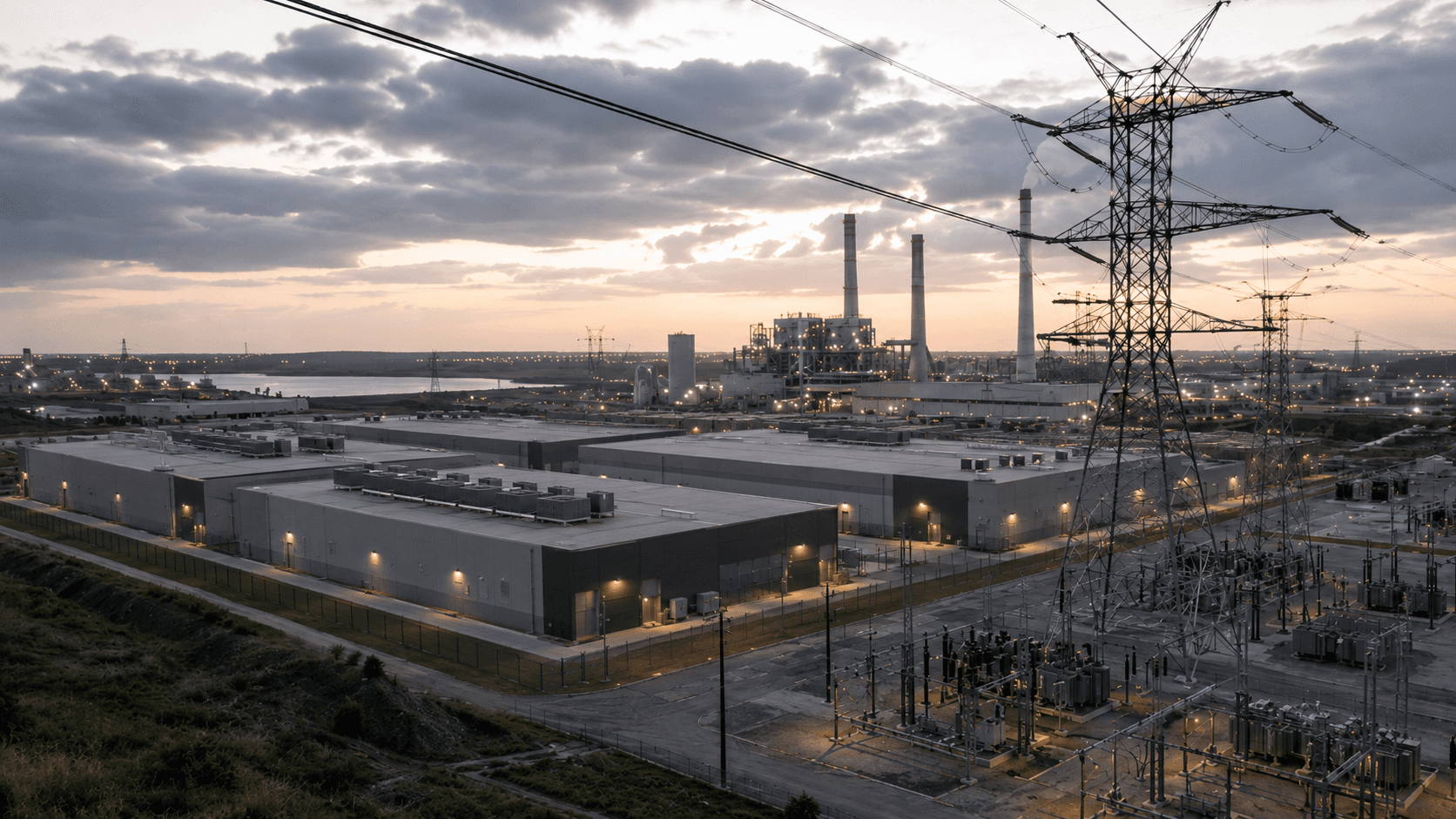
How close this forecast is to reality is already evident today. In June 2026, Microsoft and Chevron announced a data center in Pecos, Texas, whose power requirement is expected to reach around 2.67 GW when fully developed. Power is supplied by its own gas power plant with seven large gas turbines, completely independent of the public power grid. For context: one gigawatt is roughly equivalent to the output of a nuclear power plant. A large gas turbine delivers around 400 MW, while a modern wind turbine only about 6 MW. This data center therefore devours almost as much electricity as three nuclear power plants, around the clock.
And according to Aschenbrenner, this development is only at the beginning. For 2028, he expects clusters of 10 GW and costs in the triple-digit billions; in terms of energy technology, that is as much as a smaller US state consumes. By 2030, he even considers a single cluster of 100 GW possible, with costs of over a thousand billion dollars, which on its own would claim more than twenty percent of today's total US electricity production.
"electricity production.
The actual bottleneck
Electricity demand is growing massively faster than supply. Since 1985, US electricity production has only increased by around 60 percent. This sluggish supply side is now met by a demand that is breaking into entirely new dimensions due to artificial intelligence. According to Aschenbrenner, investments in AI infrastructure are projected to multiply from around 150 billion dollars in 2024 to about 8,000 billion dollars by 2030, which is more than a fiftyfold increase. For 2026, he estimated around 500 billion dollars. In fact, the announced investment volume by hyperscalers for 2026 now stands at around 725 billion dollars, which is already 45 percent above his estimate. These massive sums end up as revenue for suppliers. Their skyrocketing profits are one of the drivers behind the index profit growth mentioned at the beginning.
Where the energy is supposed to come from is therefore not an easy question. Solar and wind are cheap, but they do not deliver around the clock. In the short term, natural gas is stepping in, and nuclear power is also experiencing a comeback. Increasingly, operators are also relying on fuel cells that can be installed directly on-site. Common to all solutions is one goal: to bypass the years-long wait for a grid connection by generating the power supply directly next to the data center, as in the mentioned project in Texas.
Our conclusion
Electricity is becoming a strategic resource, very much like oil in the 20th century. Already, Gulf states are luring hyperscalers with cheap, almost limitless energy. At the same time, voices like Aschenbrenner warn against leaving this key infrastructure to authoritarian regimes. Because whoever controls the facilities where the most advanced AI is created possesses a strategic lever of power of the highest order. What matters is not only who builds the best models, but who owns the energy, data centers, and control.
As always, we thank you for the trust you have placed in us!
*This communication is for informational purposes only and does not constitute a personal recommendation or an independent financial analysis.
*By entering your email address, you agree to receive updates and communications from us. You can unsubscribe at any time.