A Year of Contrasts
T&V Letter Q4 2023
2023 was characterized by strong technology stocks, high interest rates, and significant regional differences. While the "Magnificent Seven" drove the US market, the Swiss stock market lagged behind due to weak heavyweights. At the same time, easing inflationary pressures raised hopes for a changing interest rate environment.


Insight
2023 showed how strongly a few technology stocks can shape the markets, while interest rates and currencies realign the starting position.
The year 2023 in one word: "The Magnificent Seven"
The Nasdaq 100, the index of large American technology stocks, has meanwhile – regardless of the rise in interest rates – achieved its highest annual performance since 1999.
At the beginning of 2023, stock markets behaved for a short time just as recession-obsessed investors had expected: poorly.
But the bleak start quickly gave way to a rally dominated by a series of big tech names linked by the hot topic of artificial intelligence: Apple, Microsoft, Alphabet, Amazon, Tesla, Meta, and Nvidia.
In June, the nickname "The Magnificent Seven" really began to take hold. By mid-year 2023, these stocks had experienced a price jump of between 40% and 180%, pulling the leading US index S&P 500 up by about 14%, which marked one of the strongest starts to a year in two decades. Without the Magnificent Seven, however, the index was flat. Since then, the strength of the stock market has broadened somewhat.
These seven mentioned stocks make up about 30% of the S&P 500. Their share is now so large that they not only dominate the US stock markets but also make up a large part of the global stock markets.
NEWSLETTER
Dear Reader
In several respects, 2023 is a year for the history books for the financial markets. Interest rates in the bond markets reached their highest level since 2007; the era of zero and negative interest rates, which had shaped the past nearly 15 years following the global financial crisis, seems to be definitely over for the moment.
Roche and Nestlé weigh on the Swiss market
Stock markets, which are normally regarded as safe havens in turbulent times – above all the Swiss SMI – were unable to escape the turmoil of last year. Quite the contrary: they were among the hardest hit by the dwindling risk appetite. The SMI heavyweights Nestlé and Roche, at least in previous years the epitome of stability and defensive character, plummeted last year by -6.70% and even -12.80% respectively, dragging the Swiss benchmark index down. The SMI ended the year with a comparatively weak return of +3.80%. Roche has now lost more than 39% since its peak in April 2022. The focus is currently – and this is not only the case for the Basel-based pharmaceutical giant, mind you – on the negative. The weak share price performance can be explained by a series of disappointments from clinical trials over the past two years, as well as missing out on the currently hottest topic in the pharmaceutical industry: weight-loss drugs.
In addition, the suddenly competitive interest rates on government bonds are likely to have taken a toll on many stocks with a defensive character (consumer goods and healthcare stocks), as investors often used these as substitutes for fixed-income securities.
_
Inflationary pressure is easing
In the fight against inflation, central banks were able to claim victories in 2023. Consumer price inflation gradually receded over the course of the year. Meanwhile, core inflation rates, excluding energy and food, are behaving more sluggishly than the broad inflation barometer, but are also pointing in the right direction. In China, the world's second-largest economy, a persistent deflation is already prevailing. This could have a positive impact on the Western world this year, as imported goods become or already are cheaper.
For the financial markets, it is now clear: the global interest rate hike cycle has come to an end. For the coming year, six interest rate cuts of 0.25% each by the American Fed are already priced into the futures markets. Accordingly, the first interest rate cut is expected to be decided at the Fed meeting on March 20, and the Fed Funds Rate is projected to drop from the current 5.50% to 4.00% by the end of 2024.
The Swiss Franc against (almost) everyone else
The prospect of a turnaround in interest rates by the US Federal Reserve has put the dollar under pressure. The USD depreciated by 8.99% against the Swiss Franc in 2023. The Euro did not fare much better, with a loss of 6.12% against the Swiss Franc.
Cryptocurrencies return with a brilliant bull market
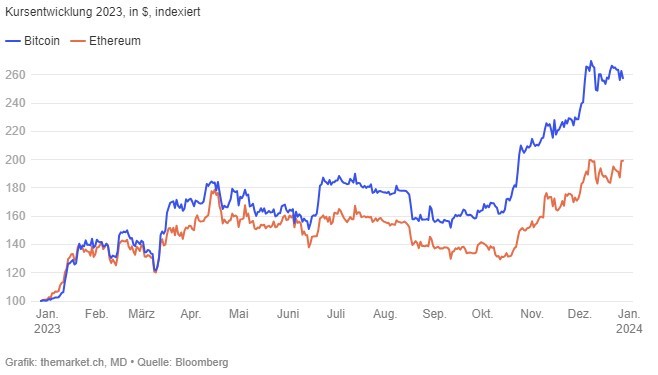
Bitcoin manages to increase two and a half times to over $42,000. Ethereum gains 100%. The possible introduction of Bitcoin/Ethereum ETFs as well as the upcoming "halving" of Bitcoin in the spring promise exciting prospects for the crypto sector.
Outlook for 2024
The likely imminent fall in interest rates worldwide should particularly boost the heavily battered shares of small and medium-sized enterprises.
As always, we thank you for the trust placed in us and we look forward to investing together in 2024!
"The most realistic distinction between the investor and the speculator is in their attitude toward stock-market movements. The speculator's interest lies in anticipating and profiting from market fluctuations. The investor's interest lies in acquiring and holding suitable securities at suitable prices." Benjamin Graham, British-American economist and investor (1894–1976)
*This communication is for informational purposes only and does not constitute a personal recommendation or an independent financial analysis.
*By entering your email address, you agree to receive updates and communications from us. You can unsubscribe at any time.