Wealth Takes Courage
T&V Letter Q3 2024
The wealth gap between Europe and the US is growing not only because of wages, taxes, or productivity. The way people save and invest also plays a decisive role. Anyone wanting to build long-term wealth needs not only discipline, but also the willingness to let capital work productively.


Insight
Anyone who wants to preserve and build wealth over the long term should not only save, but also invest.
Football fans love it when their team scores a goal from a great distance. Such goals are rare and exciting, but risky. The comparison to short-term investing is obvious: it feels good, but promises little chance of success.
Football analyst Ian Graham explains in his book "How to Win the Premier League" that only 4% of shots from outside the penalty area lead to goals, while it is 33% from within the six-yard box. It is just as difficult to predict the market over short periods of time (e.g., 1 month or 1 year). Nevertheless, many try to bet on short-term trends – similar to fans who demand a shot from distance.
Why do we act this way anyway? Three reasons:
False memories: Long-range goals and successful predictions remain more memorable than the many failures.
Quick rewards: Short-term gains are more exciting than long-term patience.
Peer pressure: Many market participants push for short-term decisions, just like fans push for long-range shots.
Long-range shots in football and short-term speculation in investing are rarely sensible. The shorter the investment horizon, the higher the uncertainty. While football thrives on risk, investments should be geared towards the long term.
NEWSLETTER
Dear Reader
Europe has long enjoyed high standards of living, characterized by a greater number of vacation days, lower crime rates, a healthy diet, and pedestrian-friendly cities – factors that in turn contribute to a higher life expectancy. The average life expectancy in the European Union is estimated at 81.5 years, compared to about 77.5 years in the US. While these hard-earned achievements are remarkable, they could be at risk if no further measures are taken to increase productivity and prosperity. The prosperity gap between the US and Europe has widened: GDP per capita in the US is around 30% higher than that of the eurozone.

Europe is beginning to worry increasingly about the growing economic and technological gap with the US. Nicolai Tangen, head of Norway's sovereign wealth fund, said in an interview with the Financial Times that Americans work harder, while Europeans are less ambitious and more risk-averse. Peter Wennink, former CEO of the Dutch chip manufacturer ASML, also warned last year that Europe is falling behind and must overcome its complacency.
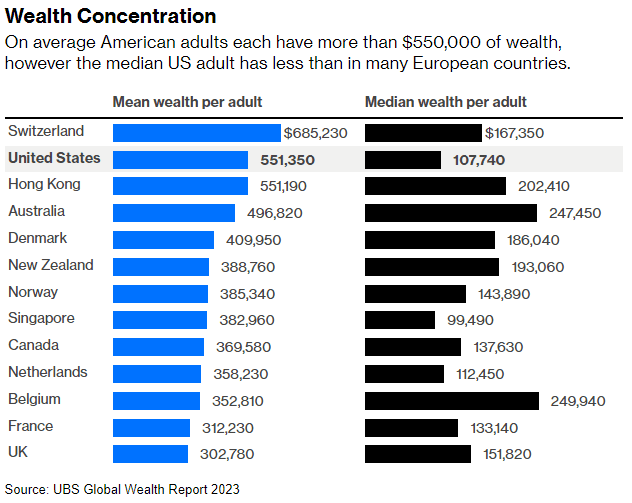
But keeping pace economically with the US is difficult for Europe, because a large part of the transatlantic gap in GDP levels can be explained by faster population growth and Washington's fiscal generosity (which may not be sustainable). Also, the higher average level of wealth in the US should not obscure the fact that this wealth is very unequally distributed; the median level of wealth in the US looks very different, as this graph shows:
Nevertheless, Americans are better off financially. A key reason for this lies in their approach to investing: they are much more likely to buy stocks, while Europeans hoard their savings in low-yield bank deposits.
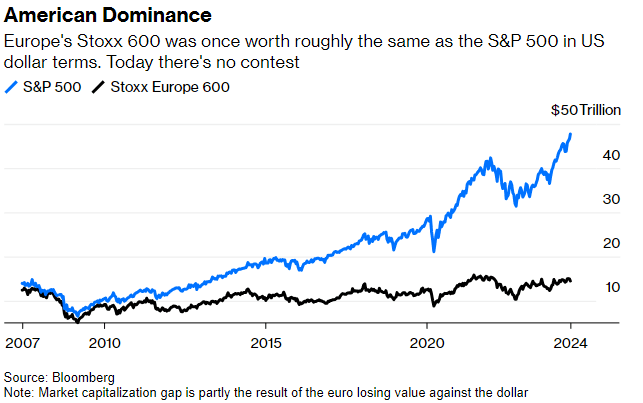
This willingness to take risks has paid off: in 2008, the market capitalization of the European Stoxx 600 in USD was roughly equivalent to that of the S&P 500; today, the difference is enormous!
The lack of European technology champions and lower spending on research and development could further widen the prosperity gap. Europe must catch up to survive in global competition – both through higher investments and more efficient use of capital.
If Europeans want to preserve their lifestyle, they must step up their efforts.
As always, we thank you for the trust placed in us!
*This communication is for informational purposes only and does not constitute a personal recommendation or an independent financial analysis.
*By entering your email address, you agree to receive updates and communications from us. You can unsubscribe at any time.